Branding for Small Businesses: The Complete Guide (2027)
What branding really is, what it costs, and how to build a small business brand step by step, from strategy and identity to guidelines and launch.

Branding for a small business is the system that shapes how people recognize, remember and choose you: your positioning, your voice, your visual identity and the experience customers have at every touchpoint. A logo is one piece of it. A strong small business brand starts with strategy, gets expressed through identity, and is protected with simple guidelines your whole team can follow.
Key takeaways
- Branding is a system, not a logo. Strategy comes first, then identity, then consistent use.
- Most small businesses need five things: positioning, messaging, a visual identity, brand guidelines and a launch plan.
- Professional branding from a boutique agency typically runs $3,500 to $12,000, depending on scope.
- Rebrand when your strategy changes. Refresh when the strategy is right but the look is dated.
- Consistency is where small brands win or lose trust, so plan how the brand will be managed after launch.
In this guide
- What is branding, really?
- Why does branding matter for a small business?
- What are the building blocks of a small business brand?
- How do you build a brand step by step?
- How much does branding cost?
- Do you need a rebrand or a brand refresh?
- How do you keep a brand consistent after launch?
- What branding mistakes do small businesses make most?
- Frequently asked questions
What is branding, really?
Branding is everything a customer uses to decide whether you are for them. It includes the obvious pieces, like your name, logo, colors and fonts, and the less obvious ones, like how fast you answer a DM, how your invoice looks and what your packaging feels like in someone's hands.
A useful way to think about it: your brand strategy decides what you stand for and who you serve, your brand identity makes that strategy visible and audible, and brand management keeps it consistent as you grow. We break down the difference in detail in brand strategy vs brand identity.
Quick test: If someone covered your logo, could a customer still tell a post, email or package came from you? If the answer is no, you have a logo, not a brand yet.
Why does branding matter for a small business?
Small businesses rarely lose to bigger competitors on quality. They lose on clarity and trust. A clear brand does three jobs at once:
- It shortens the decision. When your positioning is obvious, the right customers self-select and the wrong ones move on before they cost you time.
- It supports your price. A polished, consistent brand signals that you are established, which makes premium pricing easier to defend.
- It makes marketing cheaper. Every post, ad and email builds on the last one instead of starting from zero.
Be careful with the brand statistics you see online. The popular claim that consistent branding lifts revenue by 23 percent comes from marketers' own estimates in a survey, not measured revenue, as Showfolk's breakdown of the stat explains. The direction is right. The precision is not. We would rather show you real work, like the EntrepreNOW brand identity and website we built in Detroit.
What are the building blocks of a small business brand?
Here is the core kit we build for most small business clients. Smaller budgets can phase it; larger ones add depth.
| Building block | What it answers | What you get |
|---|---|---|
| Positioning | Who is this for, and why choose us? | Audience, category, differentiators, proof points |
| Messaging | What do we say, and how do we say it? | Tagline options, elevator pitch, voice rules, key messages |
| Visual identity | What does the brand look like? | Logo suite, color palette, typography, imagery style |
| Brand guidelines | How does anyone use it correctly? | A practical guide with do and do not examples |
| Launch assets | Where does the brand show up first? | Social templates, website direction, signage, decks |
For the full checklist of identity deliverables, see what is included in a brand identity package. For the rulebook that keeps it all consistent, see brand guidelines: what to include.
How do you build a brand step by step?
1. Start with the business goal
Branding is a business tool. Are you trying to raise prices, enter a new market, attract investors or recruit? The goal changes the work. When we rebranded the Detroit Canfield Consortium, the goal was to grow from a block club into a credible nonprofit, so the brand had to work on pitch decks and grant applications as well as merch.
2. Get specific about your audience
Write down who your best three customers are, what they were struggling with before they found you, and the words they use to describe that struggle. Those words become your messaging.
3. Define your position
Finish this sentence: "We are the only ___ that ___ for ___." If you cannot finish it without sounding like everyone else, the positioning work is not done.
4. Design the identity
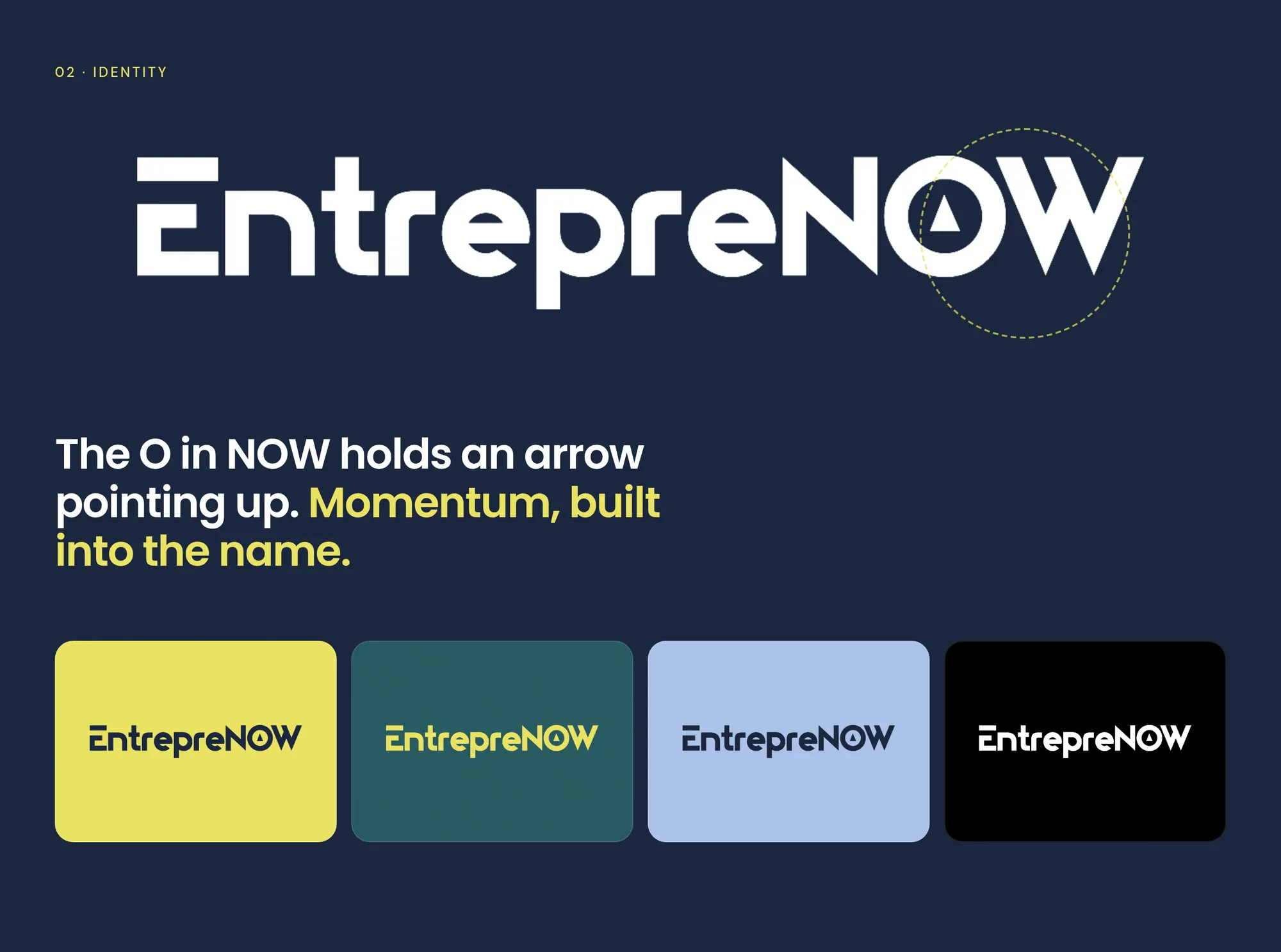
Now the visuals. Good identity design makes the strategy visible. For EntrepreNOW, an upward arrow inside the O of NOW turned the idea of momentum into a mark people remember, and a clean Poppins type system kept everything easy to read.
5. Write the guidelines
Keep them short enough that people will use them. Ten great pages beat sixty ignored ones.
6. Launch in the places customers already look
Your website, Google Business Profile, social profiles, email signature and packaging should switch over together. A staggered launch looks like two different companies. If your site needs work too, start with our small business website design guide.
How much does branding cost?
For a small business working with a boutique agency, a full brand strategy and identity typically runs $3,500 to $12,000. Logo-only design costs less, and multi-location or product brands with packaging cost more. We break down every tier, what drives the price and what to watch out for in how much does branding cost in 2027.

Do you need a rebrand or a brand refresh?
If your audience, offer or ambition has changed, you need a rebrand. If the strategy is still right and the look is simply dated or inconsistent, a refresh is faster and cheaper. Our EAP HEAT brand refresh and packaging is a good example of keeping equity while modernizing the system. Use our guide to rebrand vs brand refresh to decide.
How do you keep a brand consistent after launch?
The launch is the easy part. Most brands drift within a year as new hires, new vendors and quick Canva posts pile up. Three habits prevent that:
- Give every recurring asset a template, from social posts to proposals.
- Name one owner who approves anything public.
- Run a quarterly check with our brand consistency audit checklist.
When we took on brand management for Aunt Jackie's Curls and Coils, a brand now sold in more than 89 countries, consistency across markets was the whole job. Our brand management guide covers how to run it.
What branding mistakes do small businesses make most?
- Starting with the logo. Without strategy, you are choosing between designs on taste alone.
- Copying the category leader. Looking like the biggest competitor makes you the cheaper version of them.
- Designing for yourself. Your favorite color matters less than what your customer needs to feel.
- Skipping guidelines. The brand falls apart the first time someone else makes a flyer.
- Launching quietly. A new brand is a reason to talk to customers. Use it. Ideas in experiential marketing for small brands.
Branding by industry: beauty brands, med spas, real estate agents and nonprofits. Choosing a partner? Read our guides for Houston and Atlanta.
Frequently asked questions
What is the difference between a brand and a logo?
A logo is a symbol. A brand is the full set of impressions people hold about your business, shaped by your positioning, voice, visuals and customer experience. The logo is one tool that triggers those impressions.
How long does it take to build a small business brand?
Most strategy and identity projects take six to ten weeks from kickoff to final files. Rushing the strategy phase is the most common reason brands need to be redone later.
Can I build a brand on a small budget?
Yes. Start with positioning and messaging, which cost time more than money, then invest in a focused identity and templates. Phase packaging, merch and a full website after the core identity is set.
When should a small business invest in branding?
Invest when you are raising prices, launching a new offer, entering a new market, seeking investors or when your current look no longer matches the quality of your work.
Does branding help with SEO and AI search?
Indirectly, yes. A clear, consistent brand name, description and set of profiles helps search engines and AI assistants understand who you are and recommend you for the right queries.
Keep reading
How Much Does Branding Cost in 2027? Real Price Ranges Real 2027 branding price ranges for small businesses: logo design, full identity, rebrands and packaging, plus what drives cost and how to budget.
Rebrand vs Brand Refresh: How to Tell Which One You Need Rebrand or brand refresh? Learn the difference, the warning signs for each, real examples, costs and a simple decision checklist for small businesses.
What Is Included in a Brand Identity Package? A complete checklist of what a brand identity package should include, from logo suite and color palette to templates and guidelines, with pricing tiers.
Brand Guidelines: What to Include, With Examples What brand guidelines should include, how long they should be and how to make them usable, with a section-by-section template for small businesses.
Brand Strategy vs Brand Identity: What Is the Difference? Brand strategy vs brand identity explained simply: what each one includes, why strategy comes first, and how to tell which one your business is missing.
Ready to build a brand people remember?
Our branding projects run $3,500 to $12,000 and cover strategy, identity and the guidelines your team actually uses.

Erika Gardner, Founder and Chief Strategist, The Vibe Curator co.
Erika Gardner founded The Vibe Curator co. in 2016. She leads brand strategy, websites, email and SMS, and fractional CMO work for growing brands from offices in Houston and Atlanta.
Read Also