Small Business Website Design: The Complete Guide (2027)
Everything small businesses need to plan, design and launch a website that converts in 2027: pages, platforms, cost, SEO, AI search and mobile.

A good small business website does one job above all: it turns the right visitors into calls, bookings or sales. To get there, plan your pages around customer questions, design for phones first, choose a platform your team can update, write clear copy with real proof, and build in SEO and AI search basics from day one. Most professional small business sites cost $3,000 to $15,000, and the right one pays for itself in leads.
Key takeaways
- Plan pages around the questions customers ask before buying.
- Design for mobile first. On many small business sites, most visitors are on phones.
- Pick a platform your team can actually update: Webflow, Shopify or WordPress for most.
- Clear headings, FAQs and structured data help both Google and AI assistants find you.
- Professional small business sites typically cost $3,000 to $15,000.
In this guide
- What does a small business website need to do?
- What pages should a small business website have?
- How do you design a website that converts?
- Which website platform should a small business use?
- How do you build SEO and AI search into a website?
- How much does a small business website cost?
- When should you redesign your website?
- How do you launch a new website without losing traffic?
- What should happen after launch?
- Frequently asked questions
What does a small business website need to do?
Your website is your hardest-working salesperson. In a few seconds it has to answer three questions: What is this? Is it for me? What do I do next? Every page, section and button should help answer one of those questions.
One client told us: "Our old site was confusing and hard to update, and Erika's team came in and made everything feel clean, on-brand" and easy to manage. That is the bar. Clean, on-brand and easy to run.
What pages should a small business website have?
| Page | Job |
|---|---|
| Home | Explain what you do, for whom, and the next step |
| Services or products | One page per core offer, with price signals and FAQs |
| About | Build trust with your story, team and values |
| Proof | Case studies, reviews, before and after |
| Contact or booking | Make the next step effortless |
| Blog or resources | Answer questions and earn search traffic |
For local businesses, add location pages only when you have a real presence or real work in that area. Thin city pages can hurt more than they help.

How do you design a website that converts?
Lead with clarity
Your headline should say what you do in plain words. Clever comes second.
Design for phones first
For Crush Customs, 75.5 percent of website traffic in the first half of 2026 came from mobile. If your site works on a phone, it will work on a desktop. The reverse is not true.
Show proof early
Reviews, logos, case studies and real photos near the top of the page reduce doubt.
Use interactive tools when they help decisions
The Crush Customs rebuild added a K5 configurator with 19 colorways, which contributed to 215 add-to-carts in the first half of 2026. For Ju Sells ATL, an interactive neighborhood map and local editorial help buyers explore Atlanta before they ever call.
One primary call to action per page
Book a call, shop now or get a quote. Pick one and repeat it.
Which website platform should a small business use?
For most of our clients, the answer is Webflow for design-led marketing sites, Shopify for ecommerce, and WordPress for content-heavy sites with complex needs. We compare them in detail in Webflow vs Squarespace vs WordPress. Example: MD Newsline's Patient Circles runs on WordPress with 11 condition hubs and a 55-article library, while Lab Rascals runs on Webflow for teachers and district leaders.

How do you build SEO and AI search into a website?
- One topic per page with a clear title and description
- Question-style headings that match how people search and ask AI assistants
- A direct answer near the top of key pages, then the detail
- FAQs on service pages
- Structured data for your organization, services, articles and FAQs
- Internal links between related pages
- Fast load times, especially on mobile
- Consistent business details across your site, Google Business Profile and directories
AI assistants tend to cite pages that answer questions clearly and are kept up to date, a pattern Ahrefs found in its research on ChatGPT citations.
How much does a small business website cost?
Industry research puts most professional small business builds between $3,000 and $15,000. SiteGround's 2026 roundup cites a Clutch survey finding that 61 percent of small business buyers spent under $10,000 on their latest site. Our Digital Refresh is $3,000 flat for up to five pages, live in two weeks. Full breakdown in how much does a small business website cost.
When should you redesign your website?
When it stops doing its job: leads drop, updates are painful, it looks older than your work, or it fails on phones. Read 9 signs your website is costing you customers, then use the website redesign checklist to plan the project.
How do you launch a new website without losing traffic?
- Map every old URL to a new one and set up 301 redirects
- Keep page titles and content for pages that already rank
- Submit your sitemap to Google Search Console and Bing Webmaster Tools
- Test forms, booking and checkout on real phones
- Update your Google Business Profile and social links
- Watch traffic and leads closely for the first 30 days
What should happen after launch?
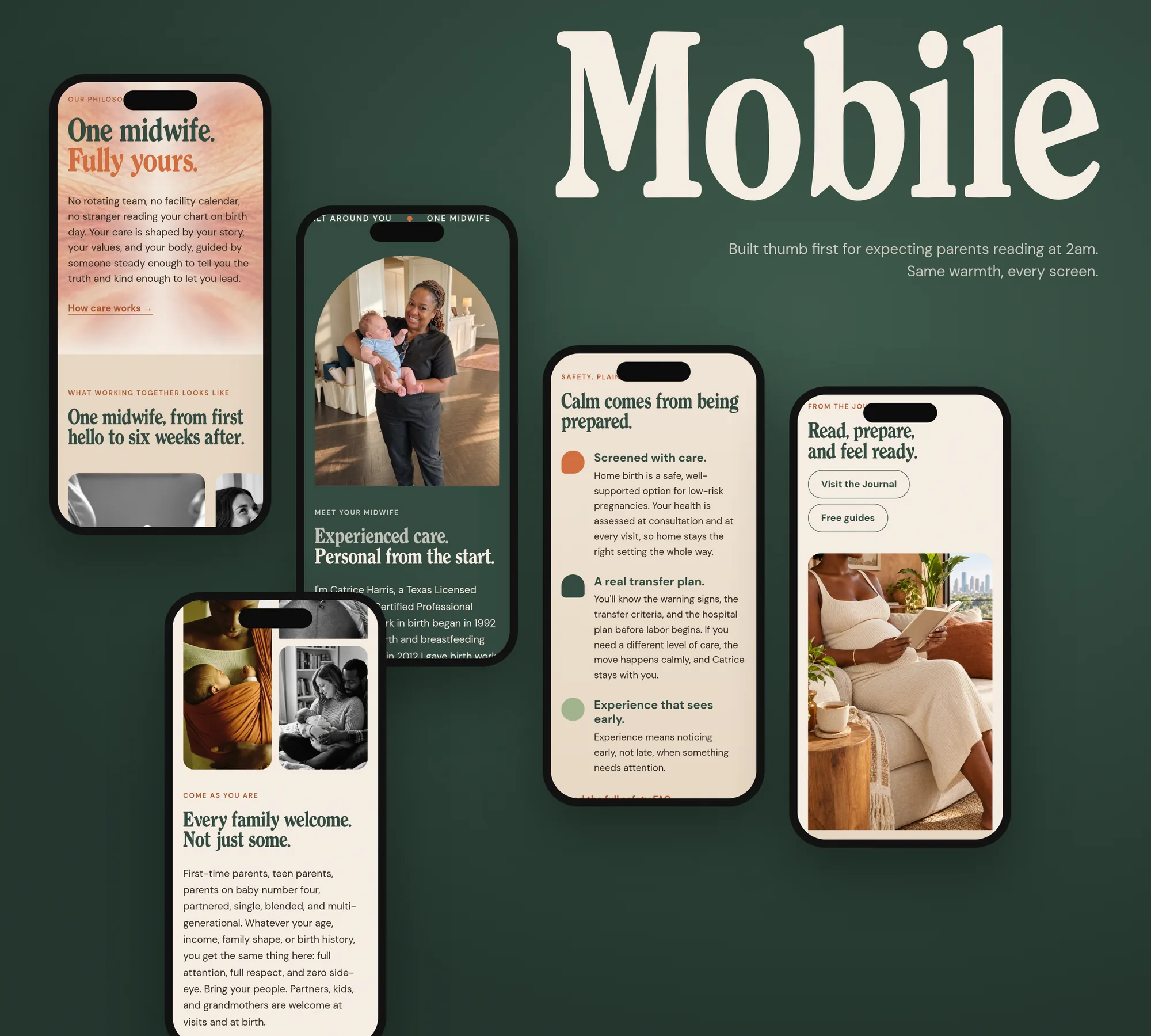
A website is never finished. Add a blog post or case study each month, refresh your top pages every quarter, and connect forms to your email platform so every lead gets a follow-up. See our email and SMS guide. If the brand itself needs work before the site, start with the branding guide. For one more example, see the brand and website we built for Baby's Best Start, a Houston midwifery practice.
Industry examples: med spa websites and real estate agent websites.
Frequently asked questions
How many pages does a small business website need?
Most small businesses do well with five to ten core pages: home, services, about, proof, contact and a blog or resources section. Add pages when you have distinct offers or questions to answer.
How long does it take to build a small business website?
A focused site of up to five pages can launch in about two weeks. Larger custom or ecommerce builds usually take six to twelve weeks.
Should I build my own website or hire a designer?
DIY works for testing an idea. Hire a professional when the website needs to generate leads or sales, when you need custom features, or when your time is worth more spent on the business.
Does my website need a blog?
If you want search traffic, yes. A blog lets you answer the questions customers ask and gives search engines and AI assistants more reasons to recommend you.
What makes a website show up in AI search results?
Clear answers to specific questions, well-structured headings, FAQs, structured data, up-to-date content and consistent business details across the web.
Keep reading
How Much Does a Small Business Website Cost in 2027? Small business website costs in 2027: DIY, freelancer and agency price ranges, ongoing costs, what drives price and how to budget for a site that converts.
Website Redesign Checklist: 25 Things to Fix Before You Relaunch A 25-point website redesign checklist covering goals, content, design, SEO, redirects, AI search, testing and launch, so your new site keeps its traffic.
Webflow vs Squarespace vs WordPress for Small Businesses Webflow vs Squarespace vs WordPress compared for small businesses: design, ease of use, SEO, ecommerce, cost and which platform fits your goals.
9 Signs Your Website Is Costing You Customers Nine clear signs your small business website is losing you customers, from slow mobile pages to vague headlines, and what to fix first.
Want a website that earns its keep?
We design and build on Webflow, Shopify and WordPress. Our Digital Refresh is $3,000 flat for up to five pages, live in two weeks.

Erika Gardner, Founder and Chief Strategist, The Vibe Curator co.
Erika Gardner founded The Vibe Curator co. in 2016. She leads brand strategy, websites, email and SMS, and fractional CMO work for growing brands from offices in Houston and Atlanta.
Read Also


