Welcome Email Sequence: Examples and a 5-Email Template
A proven 5-email welcome sequence template for small businesses, with timing, subject line ideas, examples and benchmarks for clicks and revenue.
A welcome email sequence is a series of automated emails sent to new subscribers over their first one to two weeks. A strong five-email sequence introduces your brand, delivers what you promised at sign-up, shares proof, answers objections and makes a clear offer. Welcome emails are among the highest-performing messages a business sends: Klaviyo's 2026 benchmarks put their average click rate at 6.5 percent.
Key takeaways
- Send the first email immediately and deliver the promised offer or resource.
- Five emails over 10 to 14 days is a strong default.
- Each email should have one job and one call to action.
- Welcome emails averaged a 6.5 percent click rate in Klaviyo's 2026 benchmarks.
In this guide
Why do welcome emails perform so well?
New subscribers are at peak interest. They just raised their hand. According to Klaviyo, welcome emails average a 6.5 percent click rate, and top performers reach 13.3 percent with revenue per recipient of $13.27. Klaviyo's email benchmarks also show that nearly 48 percent of flow revenue comes from new buyers, which is exactly who a welcome series serves.
What is a good 5-email welcome sequence?
| Timing | Job | |
|---|---|---|
| 1. Welcome and deliver | Immediately | Thank them, deliver the offer or resource, set expectations |
| 2. Your story | Day 2 | Why you exist and who you serve |
| 3. Proof | Day 4 | Reviews, a customer story or case study |
| 4. Objections | Day 7 | Answer the top three questions people ask before buying |
| 5. Clear offer | Day 10 to 14 | Make the next step obvious, with a reason to act now |
What should each email say?
Email 1: Welcome and deliver
Subject line ideas: "You are in. Here is your [offer]" or "Welcome to [Brand]"
Deliver what you promised in the first line. Then tell them what to expect: how often you email and what kind of content. Keep it short.
Email 2: Your story
Subject line idea: "Why we started [Brand]"
Founder stories work, especially with younger audiences. LoyaltyLion's research found 56 percent of Gen Z value interactions with founders.
Email 3: Proof
Subject line idea: "What [customer name] said after [result]"
Use a real review, a before and after, or a short case study. Real beats polished.
Email 4: Objections
Subject line idea: "Your top questions, answered"
Price, timing, fit, process. Answer them directly. This email often drives more replies than any other.
Email 5: Clear offer
Subject line idea: "Ready when you are" or "Your offer ends Friday"
One offer, one button. If you use a deadline, make it real.
How should service businesses adapt the sequence?
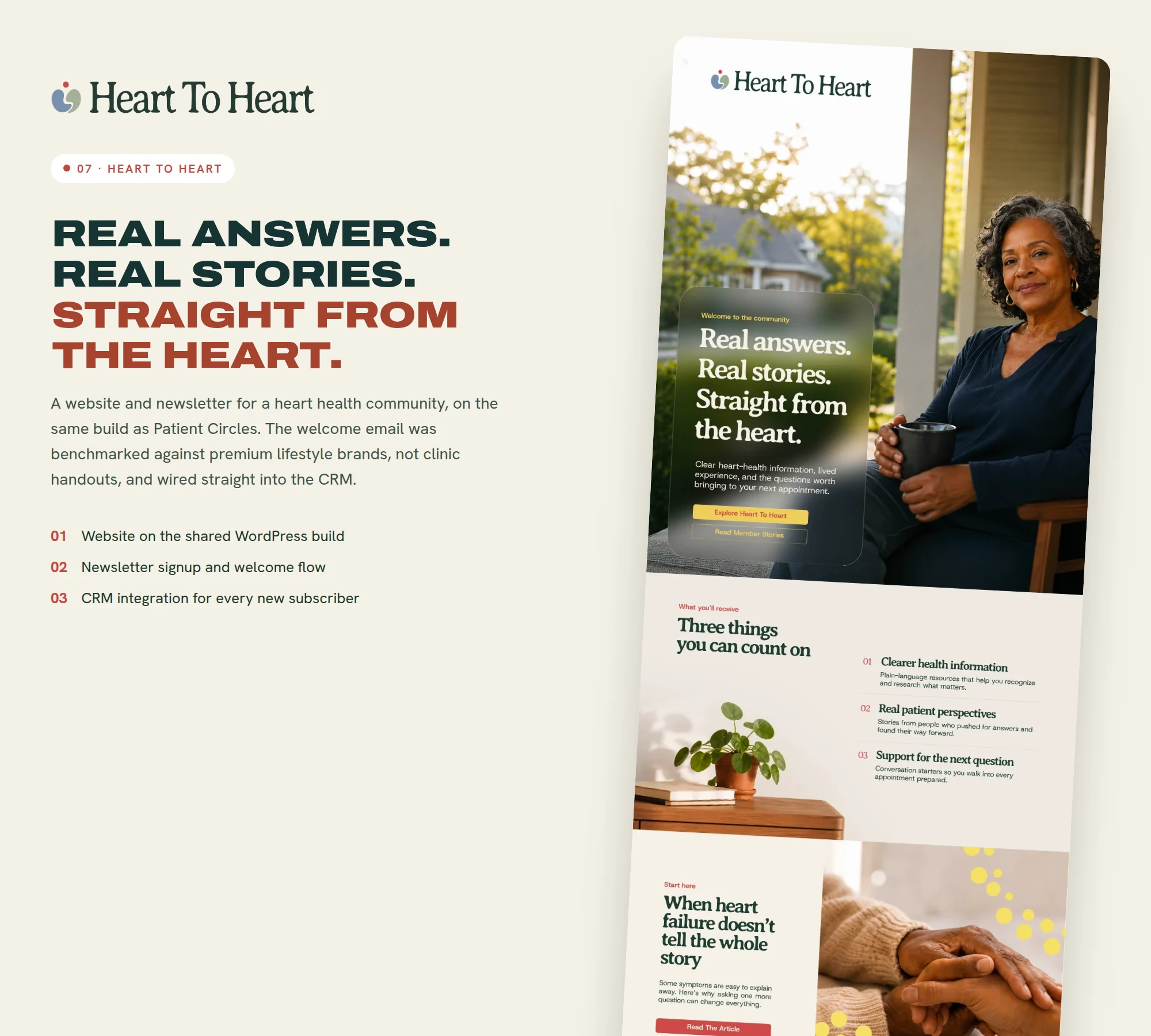
Swap the product offer for a booked call, consultation or quote. Add a short video from the founder or lead. For MD Newsline's Patient Circles, we connected the Heart to Heart newsletter's welcome email to the CRM so every new reader got the same warm introduction before regular issues began.
Should you add SMS to the welcome series?
If the subscriber opted in to texts, a single SMS on day one or day three can lift results, since Klaviyo's benchmarks show SMS flows averaging a 9.65 percent click rate. Keep it short and do not repeat the email. Follow the consent rules in SMS marketing rules for small businesses, and see email vs SMS for how to split the jobs.
What mistakes should you avoid?
- Delaying the first email. Send it within minutes.
- Asking for too much too soon. Earn the sale over the series.
- Generic copy. The welcome series should sound unmistakably like your brand. See keeping your brand consistent across channels.
- No exit. When someone buys, move them to a post-purchase flow.
How do you measure a welcome series?
Track click rate per email, conversions or bookings from the series, and revenue per recipient. Test one thing at a time, starting with Email 1's subject line and offer. For the full email and SMS system, read the complete guide. For budgets, see email and SMS costs. For event sign-ups, pair this with experiential marketing ideas.
Frequently asked questions
How many emails should be in a welcome sequence?
Three to five emails over one to two weeks works for most small businesses. Five gives room for story, proof and objections before the offer.
When should the first welcome email be sent?
Immediately after sign-up. Interest is highest in the first minutes.
Should a welcome email include a discount?
It can, especially in ecommerce. Service businesses often perform better with a useful resource or a free consultation instead.
What is a good welcome email click rate?
Klaviyo's 2026 benchmarks put the average at 6.5 percent, with top performers around 13.3 percent.
Keep reading
Email and SMS Marketing for Small Businesses: The Complete Guide How small businesses can build email and SMS marketing that drives revenue: list growth, automated flows, campaigns, consent, benchmarks and costs.
Email vs SMS Marketing: Which One Should You Start With? Email vs SMS marketing compared for small businesses: click rates, costs, consent, best uses and how to combine both channels without annoying customers.
How Much Do Email and SMS Marketing Cost? Email and SMS marketing costs for small businesses: platform fees, per-text costs, agency retainers and how to budget for a program that pays for itself.
SMS Marketing Rules for Small Businesses: Consent Basics Plain-language U.S. SMS marketing rules for small businesses: TCPA consent, disclosures, quiet hours, opt-outs and the 2026 FCC update. Not legal advice.
Want email and SMS that sell while you sleep?
Our email and SMS programs run $1,500 to $4,000 a month and start with the automated flows that drive the most revenue.

Erika Gardner, Founder and Chief Strategist, The Vibe Curator co.
Erika Gardner founded The Vibe Curator co. in 2016. She leads brand strategy, websites, email and SMS, and fractional CMO work for growing brands from offices in Houston and Atlanta.
Read Also


